‘Tin Can Coast’ Review: A Paradise of Sardines and Abalone
BOOKSHELF, Wall Street Journal
‘Tin Can Coast’ Review: A Paradise of Sardines and Abalone
By Julia Flynn Siler,
August 8, 2026
The California Current stretches some 1,900 miles from Canada’s Vancouver Island to the Baja Peninsula, its upwellings of nutrient-rich water from the ocean floor making the West Coast one of the most productive marine-life areas in the world.
In “Tin Can Coast,” Joseph Ogilvy explores the poetry and the beauty of this coastal world, the marine creatures who live within it, as well as the practices that are gutting it. Mr. Ogilvy, who was educated at Oxford and later became a chef, writes in propulsive prose that elevates this, his first book, above a simple history. “Once the sun’s rays are transformed into sardine or anchovy flesh, the food chain becomes a snarled, confused web of constant ambush and attack and pursuit and escape, jaws open, gullets flaring. Humpback whales rush, mouths agape, at sardine schools, engulfing the fish along with the water they swim in, then driving the water out through frayed baleen plates in their vast mouths and leaving the sardines to be digested.”
The author traces the long sweep of interactions between humans and the marine world along the West Coast, starting with the ancestors of Native Americans, who paddled the kelp highway across the Pacific to present-day California from northeast Asia.
The book initially focuses on the Chumash people, on Southern California’s Channel Islands, who once fished from small boats made of bundled reeds. To the Chumash, “a school of sardines would have looked like an enormous, dark shadow passing beneath the water.” The book ends with Mr. Ogilvy’s elegiac visit to Terminal Island in the Port of Los Angeles, the site of an old Japanese fishing village and where much of the seafood now imported into California first arrives.
In between, he documents the steep decline, in recent decades, of the region’s commercial fishing industry. The roots of this falloff reach back to the 18th and early 19th centuries, as fur hunters from Russia and elsewhere nearly wiped out the West Coast’s once-abundant otter population. This, Mr. Ogilvy argues, was “California’s original sin,” upsetting the coast’s ecological balance.
A doleful tale, but Mr. Ogilvy also leavens it with humor. “In all their millions of years of existence,” he writes, there had “never been a better time or place to be an abalone” than California in the mid-19th century, “and there likely never will be. It was a golden age of flourishing gastropods” because their chief predator, the otter, had been nearly eradicated from the region.
“Tin Can Coast” ranges from Japanese abalone divers in rubber suits to the poet George Sterling, the “high priest of the abalone eaters,” and his circle’s beachside abalone cookouts; from the advertising of canned tuna as “chicken of the sea” to the fish-gut smell in Monterey, whose civic leaders once set up a Smelling Committee to grapple with the unpleasant odors emanating from its canning industry toward tonier Carmel-by-the-Sea.
Mr. Ogilvy, who has worked in restaurants in London and Austin, Texas, couldn’t resist including a recipe for preserved abalone with instructions to use a cauldron “large enough to boil a man.” And who knew that 19th-century San Francisco socialites ground up iridescent abalone shells and sprinkled them on their invitations?
The author’s experience as a chef comes through in his writing. Visiting one celebrated restaurant in San Francisco, he describes the preparation of commercially farmed abalone steaks as someone who knows his way around a commercial kitchen. “The shucked abalone is trimmed, butterflied, and thwacked lightly with a mallet.” The chef then “slips the abalone medallions into a pan of hot garlic butter that’s just stopped foaming and cooks it on a gentle heat until the edges just start to think about curling, maybe a minute and a half all in.”
The chapters on the doctrine of “maximum sustainable yield” in fishery management and the fraught international negotiations of fishing rights are a bit of a slog. But they’re offset by Mr. Ogilvy’s stunning descriptions of the work in places such as Tunaville—the ethnically Portuguese fishing community of Point Loma, near San Diego—and on fishing boats. “Up close it looked like chaos, a whirl of flying fifty-pound fish and bamboo, gouging hooks and blood, spray and rolling deck. Hooks snagged on faces, snagged tuna barreled into shoulders and chests, fishermen tumbled into the foam-whipped waters.”
Still, Mr. Ogilvy’s conclusions are dire. He notes there is hardly a commercial fishing industry in California anymore and that once-abundant marine life, such as abalone, has become a culinary privilege for the elite. For commercial abalone farmers, “four years is a long time to raise a shellfish to the size of a duck’s egg.”
“Tin Can Coast” is, ultimately, a powerful eulogy to a now nearly vanished world—still remembered by some through such imaginative works as John Steinbeck’s “Cannery Row” (1945) and institutions such as the Monterey Bay Aquarium. As Mr. Ogilvy writes, “now the abalone live in hatcheries, the sardines in tanks, the tuna in the fish holds of charter boats and gourmet custom cans.” It’s a profoundly sad story, beautifully told.
— Ms. Siler is the author of “The White Devil’s Daughters.” To read the article on the WSJ site, please visit here.
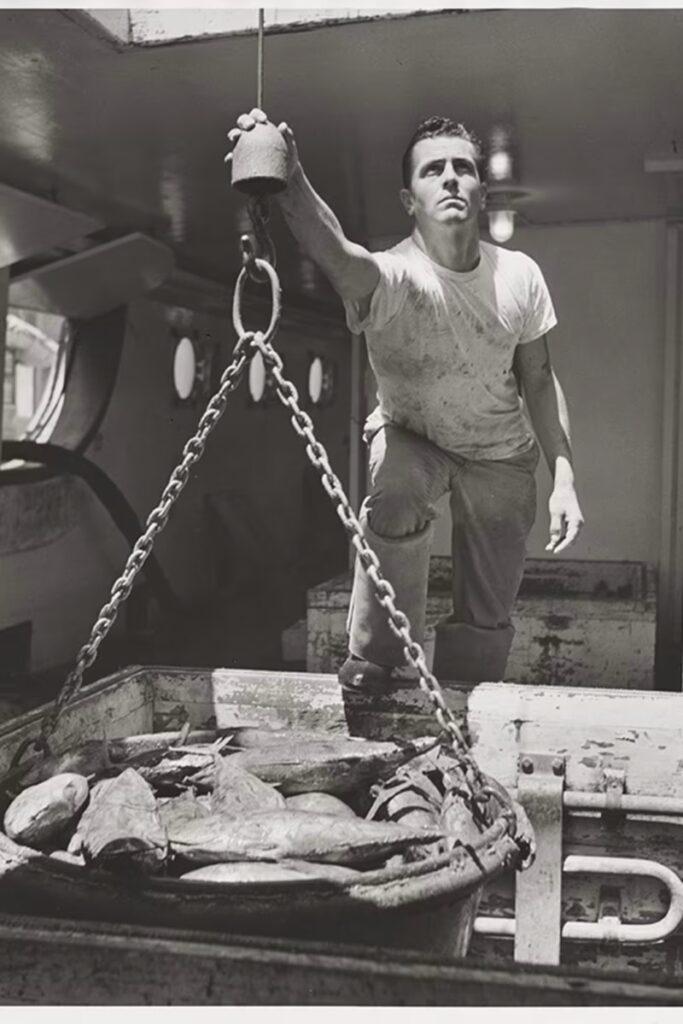
A worker at a fish cannery on Terminal Island, Calif., in 1953. Getty, courtesy WSJ